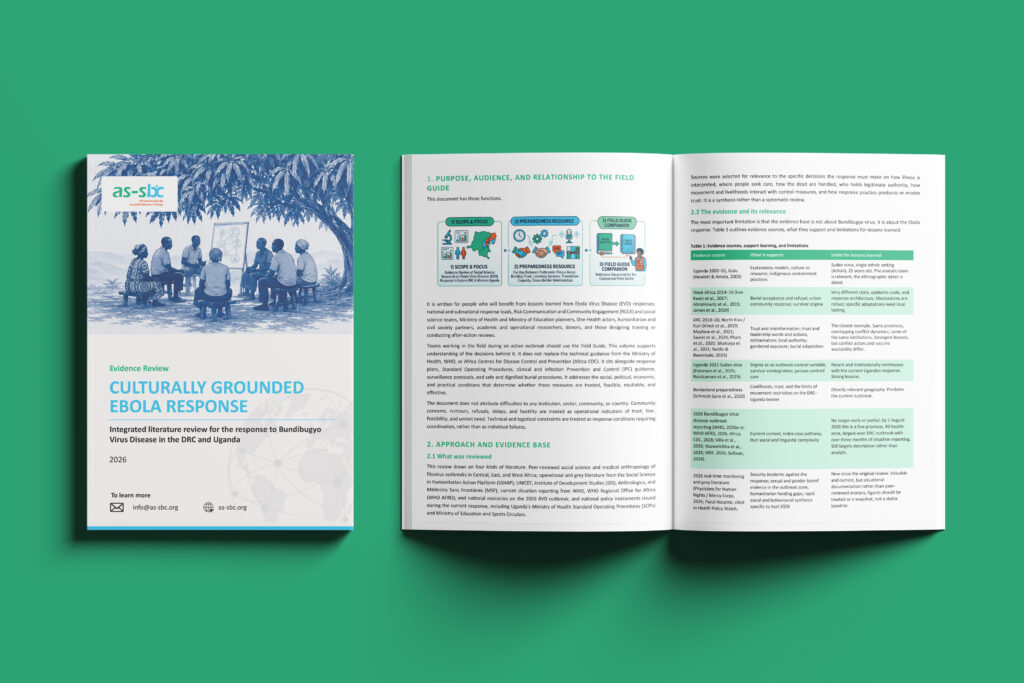
Culturally grounded Ebola response
“Technical guidance alone does not stop an outbreak—people do.”
Discover the evidence base behind culturally grounded, effective public health responses in the AS-SBC Evidence Review: Culturally Grounded Ebola Response.
Synthesising social science and medical anthropology from across Central, East, and West Africa, as well as real-time insights from the 2026 Bundibugyo Virus Disease (BVD) outbreak in the DRC and Uganda, this document reveals why technical solutions must be integrated with social realities to save lives.
What You Will Find Inside:
- The Biosocial Model: Learn why infection pathways are deeply tied to caregiving obligations, mobility, burial customs, and material conditions—and how to address exposure as a social structure.
- 8 Key Operational Themes Synthesised:
- Culture as a Resource: Leveraging indigenous containment practices alongside biomedical responses.
- Navigating Trust & Politicisation: Understanding how historical state presence, response conduct, and militarisation impact compliance.
- Care Pathways & Surveillance: Integrating private clinics, pharmacies, and traditional healers into early alert systems.
- Safe & Dignified Burials (SDB): Balancing infection control with family needs, viewing rituals, and dignity to eliminate mistrust.
- Survivor Stigma & Health Worker Welfare: Mitigating post-recovery discrimination and preventing frontline burnout.
- Equity & Gender Dynamics: Addressing the disproportionate impact of outbreaks on women and vulnerable populations.
- Actionable Operational Frameworks:
- The Listening Loop: A four-step method (Hear – Classify – Respond – Adapt – Report Back) to turn community feedback into operational changes.
- The Four-Decision Typology: Practical protocols to Clarify, Support, Adapt, or Review response measures.
- Failure-Mode Analysis: Classifying operational breakdowns as Triggers, Amplifiers, or Transmission Accelerators to act with urgency.
- Inter-Epidemic Preparedness: A concrete checklist covering language translation, WASH infrastructure, PPE readiness, and cross-border coordination required before the next outbreak strikes.
Who Should Read This Document?
Whether you are a national response lead, RCCE practitioner, Ministry of Health planner, researcher, humanitarian worker, or donor, this volume provides the crucial rationale behind the operational tools used in the field.
Download this Resource
Format: PDF (1.2 MB)