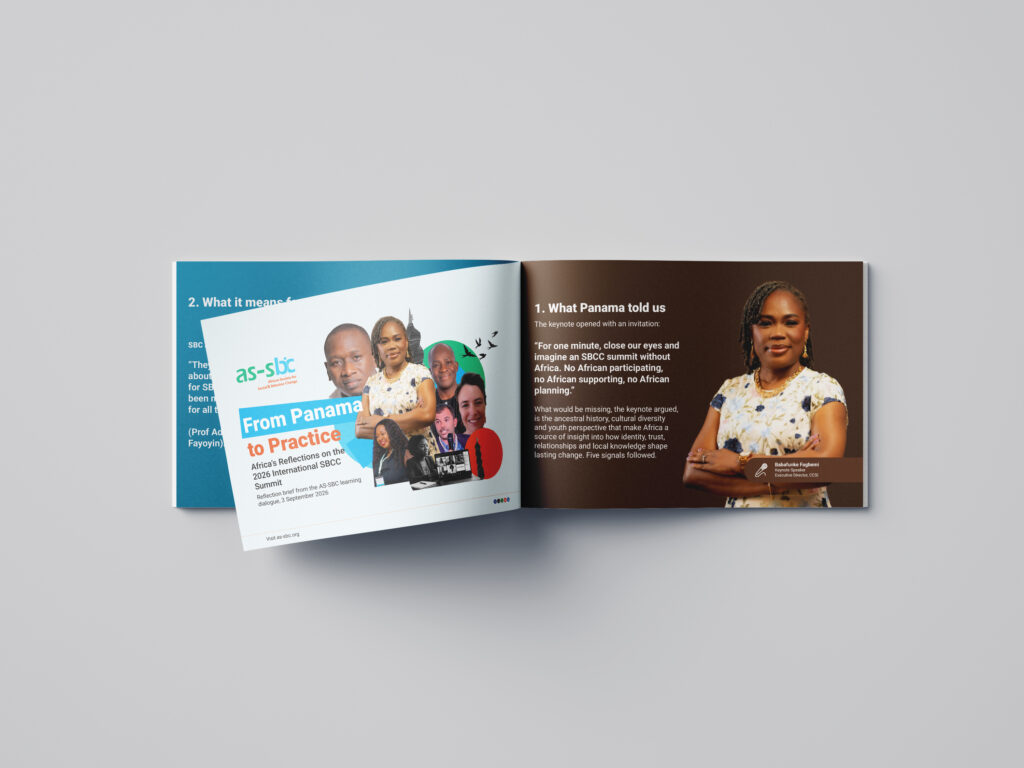
From Panama to Practice: Africa’s Reflections on the 2026 International SBCC Summit
On Thursday, 3 September 2026, the African Society for Social and Behaviour Change (AS-SBC) convened a continental learning dialogue titled From Panama to Practice. Bringing together more than 90 leaders, practitioners, researchers, and policymakers from across Africa, Asia, Europe, and the Americas, the session served as a strategic post-mortem following the 2026 International SBCC Summit held in Panama City.
Rather than recounting the proceedings of the Summit, the dialogue used Panama as a critical point of departure. It directly confronted the structural shifts, power dynamics, and unresolved tensions shaping the future of SBC across the continent through three framing questions: What did Panama tell us? What does it mean for Africa? And what must Africa take forward into practice?
What Panama Told Us: 5 Critical Signals
Delivering the keynote reflection, Babafunke Fagbemi (Executive Director, Centre for Communication and Social Impact [CCSI]; Co-Chair, 2026 International SBCC Summit) invited participants to imagine an SBCC summit without Africa—highlighting that without the continent’s cultural diversity, youth, and ancestral history, the global field would lose its foundational understanding of trust, identity, and community-led change. She identified five major signals emerging from Panama:
- Bridging the Intergenerational Gap: Panama welcomed young people to the planning table as active partners rather than passive targets. The continent must now institutionalize this shift, ensuring young professionals are funded and trusted to design and lead programmes while respecting African social structures.
- AI Must Earn Trust: Faster evidence is not inherently better evidence. While the Summit exposed a deep appetite for artificial intelligence, safeguards, and standards, African practitioners must sit at the governance table from the outset rather than having foreign, retrofitted frameworks imposed on local contexts.
- Designing With Communities, Not For Them: Context always supersedes templates. Global frameworks must be interrogated to ensure they reflect African heritage, linguistic nuances, and lived realities rather than rhetoric.
- Building Institutions That Outlive Projects: Short-term, projectised funding cycles must give way to durable African institutions capable of preserving local knowledge, maintaining long-term research capacity, and avoiding institutional amnesia.
- African Expertise Is Not the Issue: African delegates faced disproportionate logistical barriers—including visa denials, high travel costs, and hostile immigration processes. The field must counter negative perceptions and reinforce the continent’s standing as an equal, sovereign partner.
What Africa Takes Forward: Actionable Commitments
The dialogue concluded with a structured transition into concrete, trackable institutional mandates across country chapters and the Society Secretariat
Download this Resource
Format: PDF (1.2 MB)