Turning Health Rules into Real-World Action
“Technical measures fail if people cannot realistically follow them.”
When responding to public health emergencies, success depends on whether rules are trusted, feasible, equitable, and actionable on the ground.
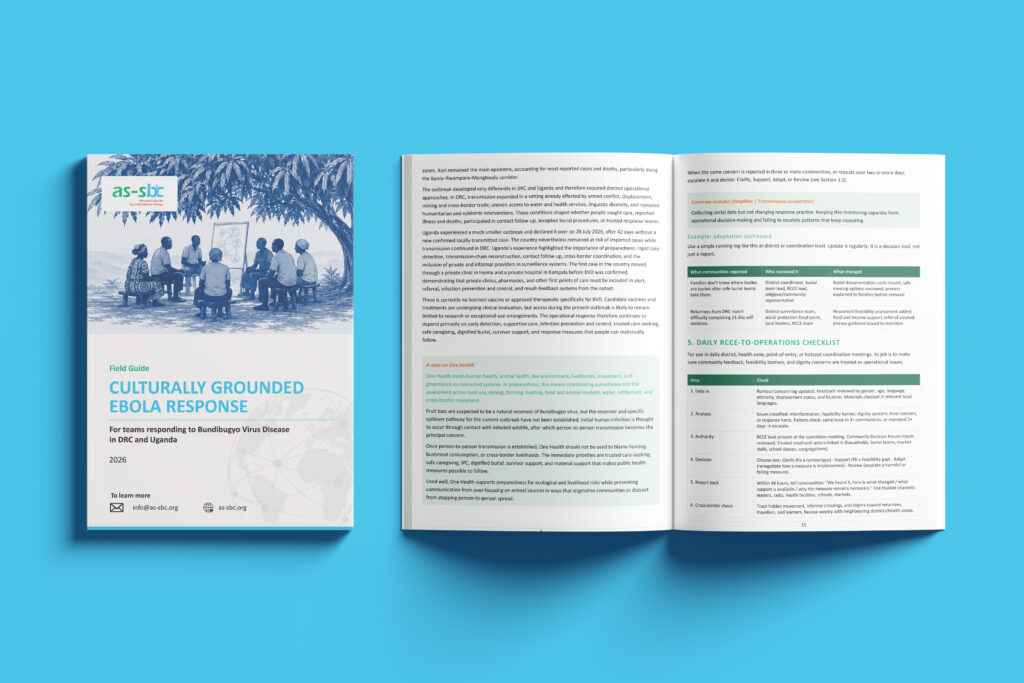
The AS-SBC Field Guide: Culturally Grounded Ebola Response provides field teams, district health leads, and community engagement officers with practical tools to translate technical outbreak guidelines into community-led solutions. Developed during the 2026 Bundibugyo Virus Disease (BVD) outbreak in the DRC and Uganda, this guide bridges the gap between biomedical protocols and daily social realities.
What You Will Find Inside:
- The 6 Core Operational Principles: Learn how to treat Ebola as a biosocial epidemic, build trust through action, protect human dignity, and ensure response measures are realistic for communities.
- 13 Practical Operational Areas:
- Care Pathways & Isolation: Strategies to integrate private clinics, pharmacies, and traditional healers into early surveillance pathways.
- Safe & Dignified Burials: Actionable adaptations (such as transparent body bags, family viewing, and community burial liaisons) that preserve dignity while preventing transmission.
- Community Governance: Concrete guidance on establishing local Community Decision Forums representing women, youth, Mbuti Indigenous populations, and displaced groups.
- Communication & Listening: Auditing local languages, addressing rumours through social diagnosis, and replacing top-down messaging with participatory dialogue.
- Support for High-Risk Settings: Guidance tailored for schools, faith institutions, public markets, transport hubs, and border crossings.
- Frontline Welfare & Equity: Tools to mitigate survivor stigma, protect health worker mental health, and monitor gender-based violence (GBV) risks.
- Daily Action Tools:
- Classified Failure-Mode Indicators: Identify and fix operational breakdowns (Triggers, Amplifiers, and Transmission Accelerators).
- The Daily RCCE-to-Operations Checklist: A step-by-step checklist for daily taskforce meetings to ensure community feedback directly changes field operations.
- Adaptation Dashboard: A template log to document community feedback and track operational adaptations.
Who Should Download This Guide?
- Frontline Risk Communication & Community Engagement (RCCE) Teams
- District & Health-Zone Incident Management Teams
- Ministry of Health & Education Planners
- Surveillance Officers, IPC Specialists, and Safe Burial Teams
- Humanitarian Partners, Civil Society Organizations, and NGO Responders
Download this Resource
Format: PDF (1.2 MB)